Bidirectional language operations

English to French and French to English translation

Run contextual translation, QA, LQA, human editing, approvals and delivery in both directions. Each direction keeps its own audience, industry, terminology, script and regional rules.

Two source languages, two sample outputs

Reveal a contextual example in either direction

The source is written in the stated source language and the output comes from the base model through our refined translation harness. The examples use commercial content associated with these markets and can be improved further with your approved content, terminology and project rules.

en → fr-FR

English to French

For organisations in the UK, North America and international English-speaking markets publishing for France and Francophone markets.

Aerospace source

English

For France and Francophone markets, a maintenance bulletin protects sequence, units and controlled technical terms.

Related aerospace workflow

fr-FR → en

French to English

For organisations in France and Francophone markets selling, reporting or operating across the UK, North America and international English-speaking markets.

Aerospace source

French

Pour la France et les marchés francophones, un bulletin de maintenance protège la séquence, les unités et les termes techniques contrôlés.
Related aerospace workflow

Compare the languages

History, reach and regional variation shape the brief

English

West Germanic family. English has more than 1.4 billion native and second-language users worldwide.

English has a written history of more than 1,300 years, from Old English through a highly international modern language.

British, American, Canadian, Australian and many other standards differ in spelling, terminology, tone and usage.

Open the English guide

French

Romance family. More than 300 million people speak French worldwide, including second-language users.

French developed from the spoken Latin of Roman Gaul, with recognisable Old French texts from the ninth century.

Major national and regional standards include France, Canadian, Belgian, Swiss and African varieties.

Open the French guide

Speaker totals are rounded estimates. Sources and censuses differ on native speakers, second-language users and the boundary between a language and a dialect.

Contextual translation workflow

The base model improves when the project supplies the rules

LanguageOps can combine research, market and audience instructions, terminology, style guidance, translation memory, previously approved content, reference files and surrounding segments. QA and LQA then test and refine the result instead of treating the first output as automatically final.

  1. PrepareExtract the file safely and attach the brief, memory, terms, research and reference context.
  2. TranslateRun the base model through the refined harness, reuse approved memory, or import an existing human translation.
  3. CheckRun deterministic QA and cross-lingual LQA for regional English, tone and terminology, numbers and placeholders, register and formality, gender agreement.
  4. EditUse a linguist, reviewer, bounded model fix or combined workflow according to risk.
  5. DeliverApprove, update reusable language assets and return the required original format.

Optional pivot workflow

Perfect the message in a pivot language before multiplying it

When source copy is ambiguous or highly market-specific, teams can first create and approve a precise English pivot. Terminology, claims and intent are settled once, then the approved pivot and its context support more reliable delivery into additional languages.

Controlled pivotEnglish source → approved English pivot → French and other targets

Bring your own translation

QA, LQA and edit human translation in either direction

Agency or internal drafts

Import bilingual work from your current supplier, internal speakers or another system and retain the existing source-target relationship.

Objective checks

Find missing content, number and tag problems, terminology drift, inconsistent repetitions and linguistic issues before delivery.

Controlled remediation

Let humans edit directly, use the base model to propose bounded fixes, or require specialist approval for sensitive material.

Cross-border content

The uk, north america and international english speaking markets and France and Francophone markets exchange more than words

English expertise for French readers

Software, financial services and ecommerce organisations commonly need product descriptions, specifications, tenders, distributor material and after-sales support for France and Francophone markets.

French expertise for English readers

Aerospace, luxury goods and tourism work often brings catalogues, ecommerce feeds, compliance information, software, contracts and operational documentation into the UK, North America and international English-speaking markets.

Inside LanguageOps

Configure the route once

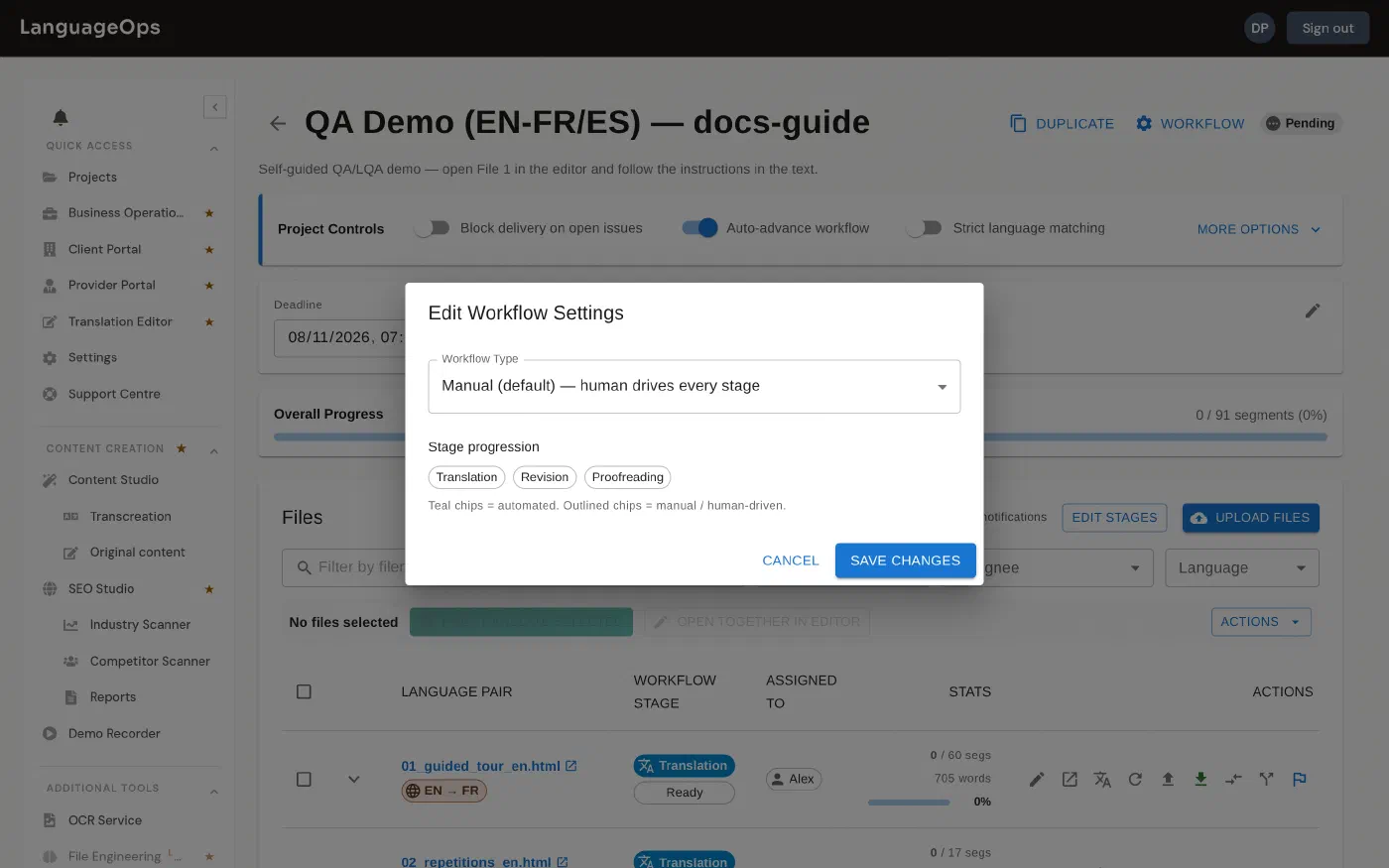
Choose translation, QA, LQA, fixing and finalisation stages, then reuse the workflow across files and languages.

LanguageOps project workflow settings for translation, QA, LQA and finalisation

Automation without losing control

Manage a single file or an international content operation

Automate preparation, translation, checks, assignments, review and delivery while keeping the project, language assets and decisions visible.

Projects at any scale

Templates, parallel language jobs, reusable memories, terminology, workflow stages, progress and approvals remove repetitive project administration.

MCP for agent users

LanguageOps MCP will let compatible agents prepare work, run approved translation and quality workflows, monitor progress and return results from the tools where teams already work.

CLI for developers

Use the LanguageOps CLI for local files, scripts, repeatable bulk jobs and CI/CD. API-led teams can connect repositories and content systems to the same controlled workflow.

Humans stay in the loop

Assign linguists, reviewers and subject experts where the content requires them, with comments, edit history, QA/LQA evidence and final approval in one place.

Explore LanguageOps MCP and CLI automation →

See it on your content

Run the workflow with your languages, files and quality rules

Bring one representative file or a complete multilingual programme. LanguageOps keeps translation, human editing, QA, LQA, approvals and delivery in one scalable workflow.