Translation project management software for the work and the business behind it
Agencies and language teams usually juggle a TMS for the work, a business management system for vendors and costs, and spreadsheets to connect the two. LanguageOps keeps quotes, projects, linguists, purchase orders, invoices and reporting beside the editor, memory, AI and QA.
- Projects, people and costs together
- Unlimited production collaborators
- Reseller and white-label on Agency
The work is in one tool. Everything about the work is somewhere else.
A translation project manager spends much of the day copying information between systems: word counts into a quote, assignments into emails, deadlines into a tracker, linguist rates into a PO, finished jobs into a spreadsheet for invoicing. Each copy is a chance for an error and a reason the numbers do not match.
-
Projects and progress in one view
See every project by stage, from file processing through translation, QA and human review to completion, with segment-level progress behind each one.
-
Linguists and assignments
Assign files or ranges to translators, reviewers and proofreaders, invite unlimited production collaborators, and keep each linguist’s work and POs on record.
-
Invoices from the real job
Quote from the file analysis, raise POs for linguists, and invoice the client from the same commercial lines, so the numbers match from quote to payment.
From request to paid supplier
- Scope
Analyse the request
Upload files and get word counts and memory matches per language, so scope and cost are based on the actual content.
- Plan
Build the team
Choose the workflow stages, split large files, and assign linguists from your own network or the LanguageOps marketplace.
- Track
Watch it move
Follow projects by stage and language, answer questions in segment comments, and see where time is being spent with stage timing.
- Close
Deliver, invoice and settle
Run QA and deliver the files, invoice the client, receive supplier invoices against approved POs, and sync the lot to Xero.
What agencies and localisation teams manage in LanguageOps
All of this sits beside the translation tools, so project data and production data are the same data.
Quotes and rate rules
Price profiles and rate rules per client, language pair and service, with versioned quotes built from the actual file analysis.
Client invoicing
Issue invoices, proformas and credit notes as PDFs from project commercial lines, record payments and allocate them against invoices.
Supplier invoices
Linguists and vendors submit invoices against the payables you have approved, through their own provider portal, so nothing is billed twice.
Statements and ageing
Current client and supplier statements, ageing and payment-run review, kept separate by currency for multi-currency businesses.
Xero integration
Sync invoices, bills and payments to Xero, keeping your accounting system as the ledger of record.
Account dashboard
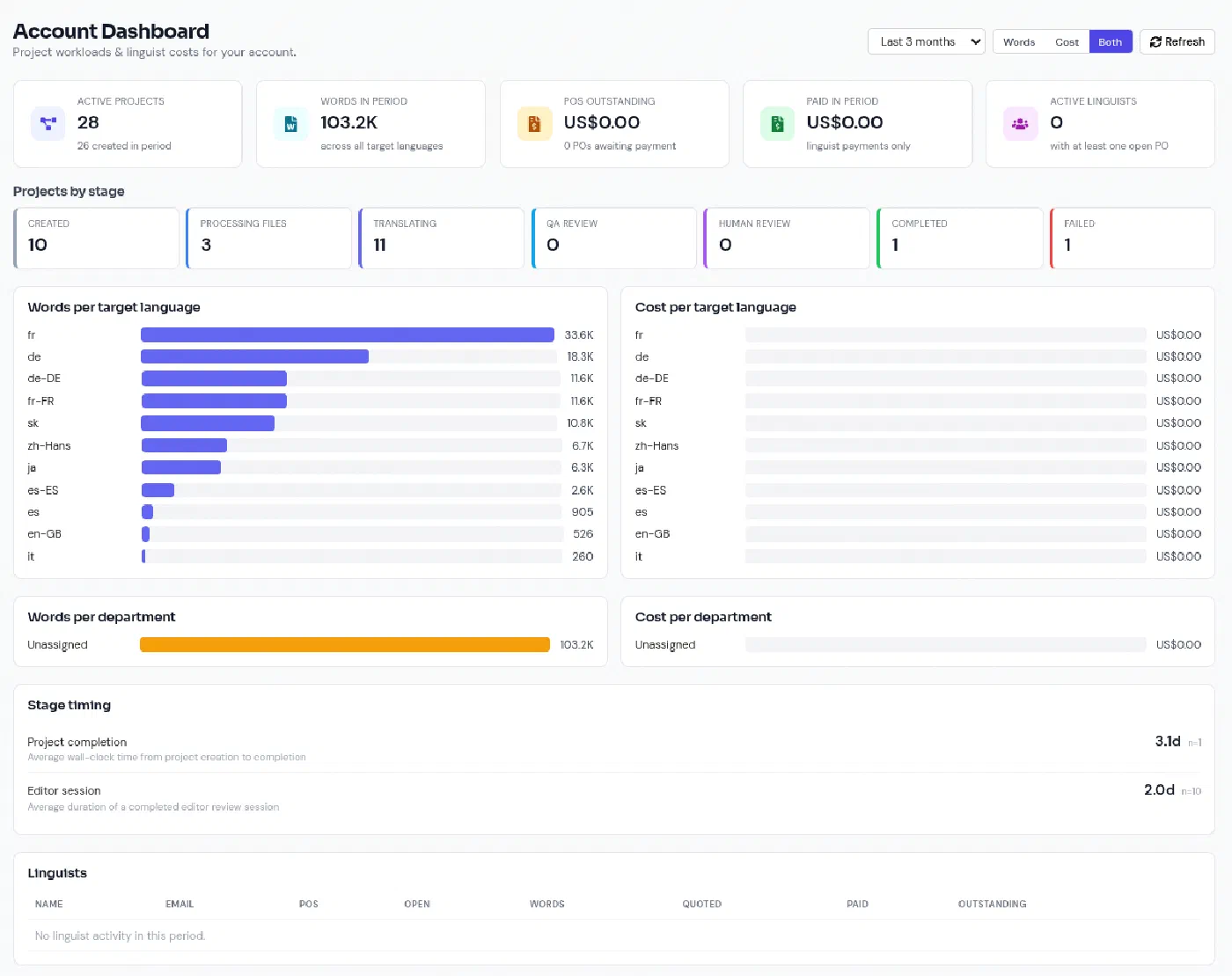
Active projects, words in period, projects by stage, words and cost per target language and department, and average time to completion.
Purchase orders
Create PO records for provider work, export them as PDFs, and track which are outstanding and which are paid.
Client and vendor records
Client accounts, contacts and terms; provider profiles with qualifications and documents; per-linguist POs, open work, words, and paid and outstanding balances.
Marketplace
Find and hire vetted linguists by language pair and specialism, or publish your own profile if you are a provider.
Workflow and notifications
Translation, review and proofreading stages with automated routing, plus in-app and email notifications for assignments, comments and status changes.
Client and provider portals
Clients submit requests, follow progress, receive deliveries and see their invoices. Providers see their POs and submit invoices. Branded client portals are available on Enterprise.
Reseller and white-label
Agency plans can resell LanguageOps to their own clients, with white-label sub-accounts on Enterprise.
API and MCP
Create projects and move files from your own systems, or let AI agents drive routine project steps.
Project management, TMS and CAT editor on every plan
Team plans start at £1,000/month for 20 management seats and 1M words, with unlimited production collaborators. Agency plans add reseller options and a dedicated account manager.
What translation project management covers
Every translation project, whether it runs inside an agency or an in-house localisation team, goes through the same stages:
- Intake and scoping: receive files and instructions, confirm languages, deadlines and quality level, and analyse word counts and memory matches.
- Quoting and approval: price the work from the analysis and agree scope with the client or internal requester.
- Preparation: convert or engineer difficult files, attach translation memory, termbase and style guide, and set up the workflow.
- Resourcing: choose translators, reviewers and proofreaders by language pair, specialism and availability, and issue assignments.
- Production: translation, review and proofreading, with questions answered in context.
- Quality assurance: automated QA and linguistic quality checks before delivery.
- Delivery: return files in their original format, or push them back to the source system.
- Close-out: update memory and terminology, pay suppliers, invoice the client and record what the job cost.
Traditional setups split these stages across two or three products. Production happens in a TMS or CAT tool, and scoping, resourcing and close-out happen in a translation business management system or a spreadsheet. The more systems involved, the more time goes on re-keying data and reconciling numbers.
TMS, TBMS or both?
| Need | Typically handled by | In LanguageOps |
|---|---|---|
| Files, formats and editor | CAT tool / TMS | Browser CAT editor, 80+ formats |
| Memory, terminology, AI, QA | TMS | Included on every plan |
| Workflow stages and assignments | TMS | Translation, review and proofreading stages |
| Linguist network and hiring | TBMS / spreadsheets | Linguist records and marketplace |
| Quotes and rate cards | TBMS | Price profiles, rate rules and versioned quotes |
| Purchase orders and supplier invoices | TBMS | POs, supplier invoice submission against approved payables |
| Client invoicing, credit notes, payments | TBMS | Invoices, proformas, credit notes, payment allocation, statements and ageing |
| Reporting by language, client area or linguist | TBMS / BI tool | Account dashboard |
| Client self-service | TBMS portal | Client portals on Enterprise |
| Accounting and statutory finance | Accounting software | Xero sync; Xero stays the ledger |
If you run the business from a separate TBMS such as Plunet or XTRF, or from spreadsheets, LanguageOps can replace both that layer and the TMS and CAT licences underneath it: quote, produce, pay suppliers and invoice clients from one set of records. If you would rather keep your TBMS, LanguageOps can still sit underneath it as the production system.
What to look for in translation project management software
- One source of truth for word counts: the analysis used to scope the job should be the same one used to pay the linguist.
- Stage-level visibility: you should see what is stuck in translation or review without asking anyone.
- Supplier records tied to real work: POs and linguist balances should come from assignments, not from a separate list.
- Invoices that match the quote: client invoices should be raised from the same commercial lines that were quoted and delivered, and flow to your accounting system without re-keying.
- Assets that improve over time: every approved job should strengthen memory and terminology for the next.
- Unlimited collaborators: per-seat pricing for freelancers makes agencies ration access. LanguageOps charges for management seats, not production collaborators.
- An exit route: TMX, TBX and XLIFF export, so your language assets are never locked in.
For agencies consolidating their stack, the TMS pricing comparison shows realistic annual costs for 1M and 5M-word workloads across LanguageOps and the major TMS vendors. If you would rather hand a project over entirely, see managed translation services.
Translation project management, explained
What is translation project management?
What does a translation project manager use software for?
What is a translation business management system (TBMS)?
What is the difference between a TMS and a TBMS?
Can I invoice clients from LanguageOps?
Does LanguageOps replace my accounting software?
Is it suitable for translation agencies?
See your agency's workflow in one system
Show us how a project moves through your business today. We will map it to projects, assignments, POs and reporting in LanguageOps.