Keep every translation consistent as your brand enters new markets
Your product name, features, claims, tone of voice, and approved terminology should not change from one file, translator, or campaign to the next. LanguageOps gives your team one place to translate, review, remember decisions, and reuse trusted language, without the cost and weight of a legacy translation system.
- One
- source of language truth
- Approved
- brand terminology
- Reusable
- translations and decisions
- Consistent
- across every market
A translation can be accurate and still feel wrong for your brand
As content spreads across product interfaces, websites, packaging, support, campaigns, and documentation, small differences accumulate. The same feature gets three names. A product claim changes tone. A new translator cannot see what was approved last time. LanguageOps turns those scattered decisions into shared, reusable assets.
-
Stop terminology drift
Define approved product names, feature terms, prohibited wording, and market-specific variants in a shared termbase. Translators see the right term while they work, and QA identifies inconsistent use before delivery.
-
Protect your brand voice
Keep style guides, audience, tone, product context, reference material, and special instructions with the project. Human and AI-assisted translation can work from the same brief instead of guessing from isolated sentences.
-
Do not solve the same sentence twice
Approved translations build a translation memory. Exact repetitions and similar passages become reusable matches, reducing duplicated effort while keeping previously agreed language visible and traceable.
Turn what your team already knows into a repeatable translation system
- Collect
Bring your language assets together
Upload existing translations, terminology, style guides, reference files, and product instructions. Import TMX or align previous source and target documents to recover useful translation memory.
- Translate
Every sentence arrives with its context
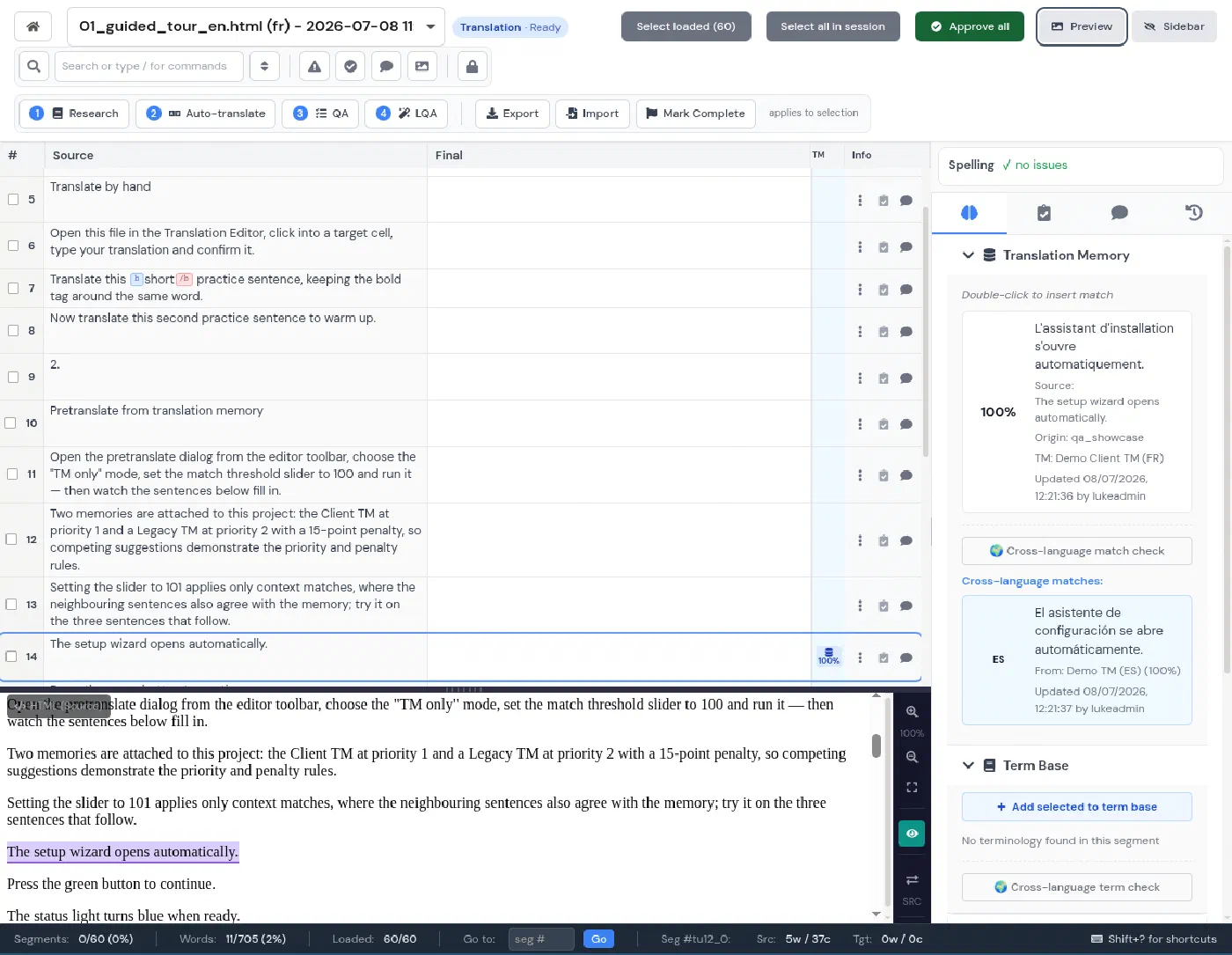
Translate documents, websites, software strings, spreadsheets, localisation files, and media with relevant memory matches, terminology, neighbouring content, metadata, and visual context available.
- Control
Review and check consistency
Use linguist review, deterministic QA, terminology checks, edit history, approvals, and optional LLM-based quality assessment to find drift before it reaches customers.
- Compound
Reuse every approved decision
Save confirmed translations and terms for the next release, campaign, or market. Your language assets improve over time instead of disappearing into delivered files and email threads.
Keep the meaning, wording, and reasoning connected
Consistency needs more than one glossary. LanguageOps combines the different kinds of knowledge that make a translation sound like the same company everywhere.
Translation memory for approved wording
Store trusted source-and-target segments and retrieve exact or fuzzy matches when similar content appears. Separate draft suggestions from reviewed language, and maintain multilingual memories for recurring products and content.
Terminology for products and markets
Track preferred and forbidden terms, case sensitivity, match behaviour, definitions, and language variants. Give French and Swiss French, or British and American English, their own instructions without losing the relationship between them.
Style and brand guidance
Attach voice, register, audience, market, client, subject matter, and product instructions to the work. Use them as reviewer guidance and, where appropriate, as controlled context for AI-assisted translation.
Decisions with a history
See edits, comments, reviewer corrections, approvals, and quality results at segment level. When wording changes, your team can understand what changed and carry the final decision forward.
The tools that keep multilingual content aligned
- Translation memory and fuzzy matching
- Multilingual terminology databases
- Preferred and forbidden terms
- Style guides and brand instructions
- Source, target, and visual context
- Translation, review, and approval stages
- Terminology, consistency, and tag QA
- AI-assisted and human-led workflows
- Comments and complete edit history
- Language and regional variants
- Reusable project templates
- Original-format delivery
For teams that have outgrown documents, spreadsheets, and disconnected AI prompts
-
Product and software companies
Keep feature names, interface strings, release notes, documentation, and support content aligned as the product expands into new languages and regional variants.
-
Brand and marketing teams
Give campaigns, websites, packaging, social content, and local market adaptations one shared voice while still allowing deliberate transcreation where literal consistency is not the goal.
-
Growing international businesses
Create a practical localisation operation before volume becomes unmanageable. Start with the assets you have, automate repeatable work, and add specialists and controls as new markets require them.
What growing brands need to know
How do you keep translations consistent across different files and translators?
What is the difference between translation memory and terminology?
Can AI translation follow our brand voice and product terminology?
Can we reuse translations we already have?
How do you handle regional language variants?
Do we need a large localisation department to use a translation management system?
How is this different from a legacy translation management system?
Build the language system your next market will need
Bring a representative product, campaign, or content set. We will show how your existing translations and brand knowledge can become a consistent, reusable workflow for every market that follows.