Automotive
Apply compound nouns rules to automotive product, operational and customer content for Germany, Austria and Switzerland.
AI translation by language
Translate for Germany, Austria and Switzerland with surrounding content, audience instructions, approved terminology, market rules and previous decisions. Start with the base model, improve human translation, or adapt a regional variant, then check and approve everything in one workflow.
Base model starting point
This German example is the base model output produced through our refined translation harness. It is the starting point before we add your context and rules. LanguageOps can research the market, use your previously approved translations and content, read document-level and neighbouring-segment context, apply terminology, style and QA rules, then use LQA to identify what should improve. The next example adds industry and market context to make the task more specific.
For the German market, the automotive team must keep product code LO-2048, the 48-hour delivery promise and the two-year warranty unchanged.
Für den deutschen Markt muss das Automobilteam den Produktcode LO-2048, das Lieferversprechen innerhalb von 48 Stunden und die zweijährige Garantie unverändert beibehalten.
QA passed: product code LO-2048 and the 48-hour promise were preserved.
Accurate, formal and technically consistent German.
Market-specific example
The project can attach the relevant audience, content type, terminology and market rules before generation. This second example uses a commercial sector associated with Germany, Austria and Switzerland.
For Germany, Austria and Switzerland, a brake-sensor product description retains the part ID, warranty and fitting terminology.
Für Deutschland, Österreich und die Schweiz behält eine Produktbeschreibung für einen Bremssensor die Teilenummer, Garantie- und Montagebezeichnungen bei.
Language and culture
Speaker totals are rounded because counts vary by census, proficiency threshold and whether second-language users are included.
Where context matters
The base model can receive the target audience, market, neighbouring segments, terminology, style guide, research, reference material and previous approved translations instead of working from an isolated sentence.
Commercial use
Apply compound nouns rules to automotive product, operational and customer content for Germany, Austria and Switzerland.
Apply formal register rules to engineering product, operational and customer content for Germany, Austria and Switzerland.
Apply technical consistency rules to chemicals product, operational and customer content for Germany, Austria and Switzerland.
Not only AI translation
Bring translation from an internal team, agency, freelancer, legacy TMS or bilingual file. LanguageOps does not require the first draft to have been generated in the platform.
Check tags, numbers, placeholders, terminology and consistency, then assess accuracy, completeness, fluency and style against the source and brief.
Correct the text with the base model, a linguist or both; record comments and revisions; and approve final wording for reuse in memory and terminology.
Monolingual localisation
Adapt spelling, vocabulary, tone, dates, currency and local terminology without translating from scratch. Relevant variants include German (Austria) and German (Switzerland).
Explore language-variant editingInside LanguageOps
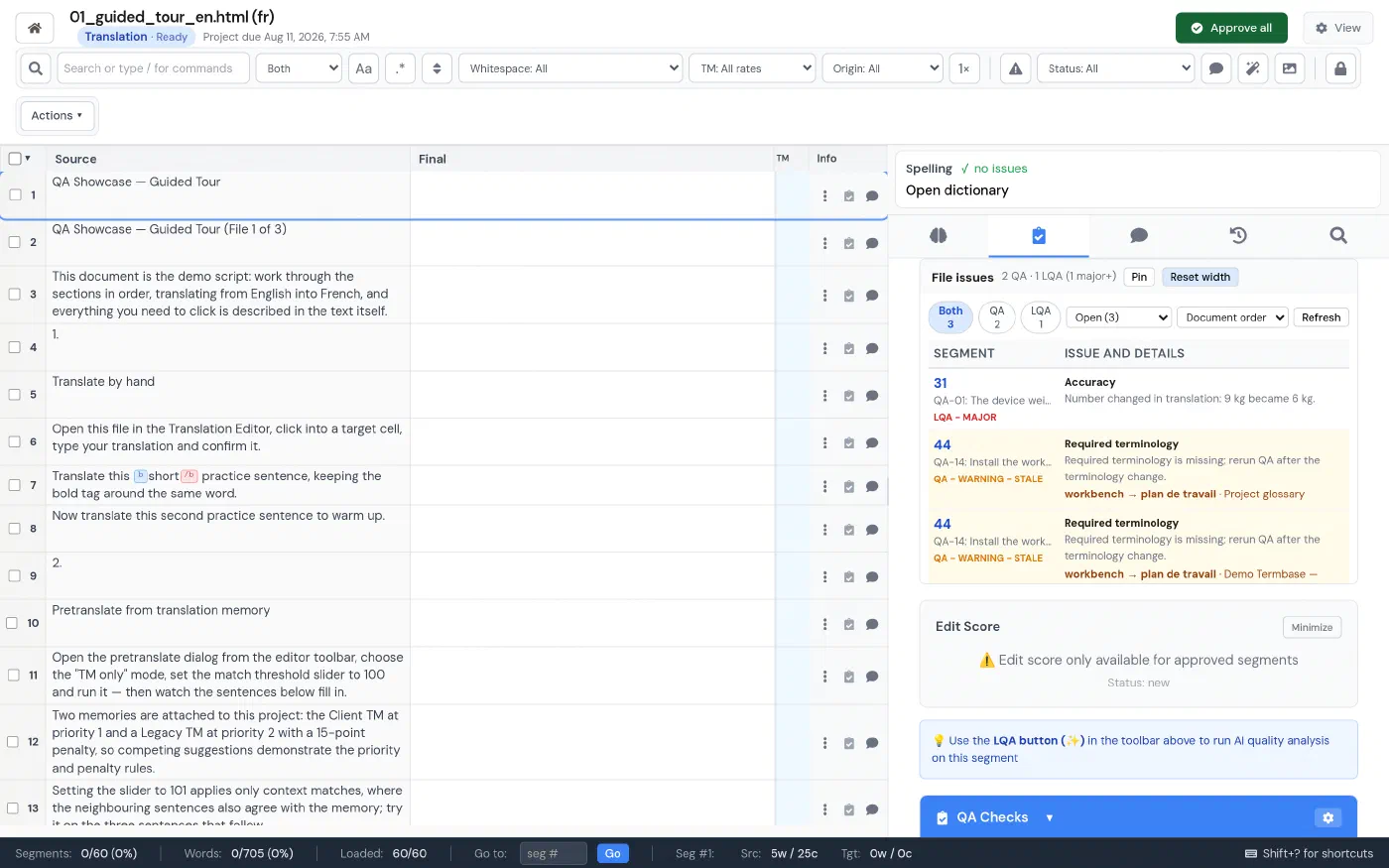
Open a focused list of deterministic QA and linguistic quality issues, jump to the affected segment and keep quality evidence connected to the work.
Automation without losing control
Automate preparation, translation, checks, assignments, review and delivery while keeping the project, language assets and decisions visible.
Templates, parallel language jobs, reusable memories, terminology, workflow stages, progress and approvals remove repetitive project administration.
LanguageOps MCP will let compatible agents prepare work, run approved translation and quality workflows, monitor progress and return results from the tools where teams already work.
Use the LanguageOps CLI for local files, scripts, repeatable bulk jobs and CI/CD. API-led teams can connect repositories and content systems to the same controlled workflow.
Assign linguists, reviewers and subject experts where the content requires them, with comments, edit history, QA/LQA evidence and final approval in one place.
See it on your content
One document or a whole multilingual programme. Tell us the languages and the deadline, and we will send a scoped price. If you would rather run the work yourself, every plan includes the same tools.